Resources / The AI build brief
A clear brief.
Before you build.
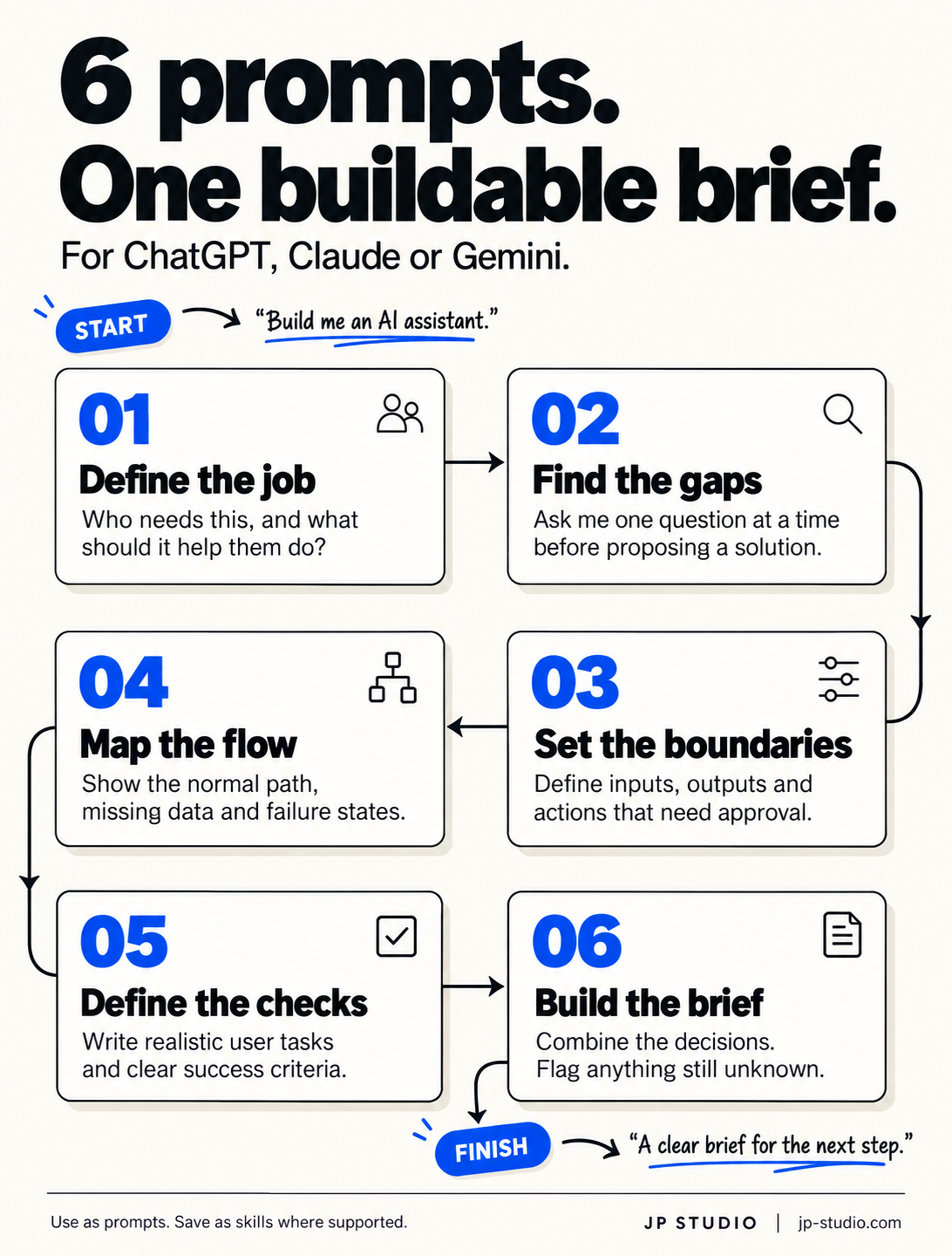
Six prompts to turn “build me an AI assistant” into decisions you can actually work with.
For ChatGPT, Claude or Gemini. Use them in order, keep your answers together, and carry the decisions into the next step.
Plain text · No sign-up · No email required
01 / How to use this
Give the next step
something solid to work with.
Start with prompt 01. Answer the questions, review the assumptions, and keep the agreed decisions in a single document. Then move to the next prompt with that context.
You can use ordinary chat apps. These are copyable prompts, not universal slash commands or a claim that every app supports installable skills.
02 / The complete prompts
From the job
to the brief.
Each step leaves you with something useful for the next one. Copy a prompt, work through it, and keep what you agree.
Define the job
Help me define the job this AI assistant should do. Establish who will use it, the task they are trying to complete, the current process and a concrete useful outcome. Separate what I have told you from assumptions. Do not propose tools or architecture yet.
What you keepA specific person, task and useful outcome.
Find the gaps
Read the current brief. Ask me one question at a time about decisions that materially change the scope. Start with the most consequential unknown. Do not silently invent requirements or suggest a solution before the important gaps are resolved.
What you keepThe decisions you need to make before building.
Set the boundaries
Using the agreed brief, list the inputs, outputs and systems involved. For each action, distinguish read access, draft creation and external changes. Identify which actions require human approval, who gives that approval and what data the assistant must not access. Mark unresolved access requirements.
What you keepClear access and approval boundaries.
Map the flow
Map one realistic task from trigger to completion. Include missing data, unavailable systems, duplicate requests, rejected approvals and a handoff to a person. For each failure, describe what the user sees and what the system may safely do next. Flag assumptions.
What you keepA workflow that includes the difficult cases.
Define the checks
Write realistic acceptance scenarios for the agreed workflow. Include the normal path and the important failures. For each scenario, give the starting state, user action and observable expected outcome. Include access boundaries and duplicate external actions. Do not claim these tests have been run.
What you keepObservable outcomes to test, not a promise of quality.
Build the brief
Combine the agreed decisions into one implementation brief: user and goal, scope, exclusions, inputs and outputs, systems and access, workflow, approval boundaries, failure handling and acceptance checks. Preserve the decisions already made. End with unresolved questions and assumptions that still need human confirmation. Do not fill gaps with invented facts.
What you keepOne brief that preserves what you have agreed.
03 / Your starting point
One brief.
Fewer missing decisions.
A useful brief gives you a way to review the work. It does not prove that the implementation is correct or secure. Test the real workflow, its permissions and its failure states.
 Open the route ↗
JP Studio
We design and build AI assistants, business automations and custom software around the way your team works.
Explore AI assistants